PPWR
Published on:
Last Updated

Biki John
Senior Content Marketing Manager

Key Takeaways
Understand what the PPWR Declaration of Conformity requires, and who is legally responsible for signing
Ability to distinguish the relationship between the DoC, technical documentation, and conformity assessment to ensure packaging compliance is properly structured and evidenced.
Learn how Recyda supports Declaration of Conformity creation and management across your packaging portfolio.
Under the EU Packaging and Packaging Waste Regulation (PPWR), which came into force in February 2025, product conformity moves from a nice-to-have to a legal conformity requirement.
According to the regulation, companies that place packaging on the EU market must adhere to:
PPWR Article 39 and Annex VIII - EU Declaration of Conformity (DoC)
Annex VII - Technical documentation (Technical file)
PPWR Article 38 and Annex VII - Conformity assessment procedure
For a basic understanding of how these 3 legal requirements relate with one another, the sequence can be seen like this:
The Declaration of Conformity is the formal statement/declaration that the packaging aligns with the requisite PPWR requirements.
The Technical Documentation provides the evidence that the packaging is actually compliant, thus giving the DoC credibility.
The Conformity Assessment Procedure is a legally mandatory, documented evaluation process that confirms that the packaging complies with PPWR.
We will explore in more depth how this 3-part sequence relates to one another further along in the article.
What is the PPWR EU Declaration of Conformity?
According to PPWR Article 39, it’s a document that declares that the PPWR requirements laid down in Articles 5 to 12 have been executed. This includes topics like freedom from harmful substances or the use of recyclates, recyclability, and material composition.
Annex VIII sets out the model structure and specific elements the documentation must possess.
This formal statement is short, however, its weight should not be underestimated. It acts as official proof and by signing it the company takes full legal responsibility for the packaging’s compliance under PPWR. Also, when the packaging changes, the DoC has to be updated so it always represents the latest version.
What type of packaging requires a Declaration of Conformity?
To enter the EU market, each packaging type, defined by its material, configuration, and format, requires its own dedicated signed declaration. For example, a company utilizing 100 distinct packaging formats must issue 100 separate declarations, with each individual document backed by its own supporting technical documentation. The FAQs of the European Commission clarify, however, that companies do not necessarily need a separate document for every single SKU. If packaging units (such as a line of bottles) are of different sizes but contain the same product, and the size variation does not affect compliance with PPWR’s sustainability requirements, the Manufacturer may draft a single DoC covering the entire size series. Documents only need to be separated if structural differences (like different material compositions) alter the packaging's compliance profile.
Who is responsible for creating the Declaration of Conformity?
PPWR Article 39 (4) mandates that the manufacturer is responsible for drawing up the documentation, and is therefore responsible for making sure the packaging is compliant with PPRW’s regulation.
That responsibility involves signing the declaration, maintaining and updating the technical documentation, and being called upon to prove compliance by authorities.
There are some exceptions:
The Micro-Enterprise Shift: If a brand owner qualifies as a micro-enterprise (fewer than 10 employees and an annual turnover/balance sheet under €2 million), and their packaging supplier is located in the same Member State, the legal role of the "Manufacturer" shifts entirely to the supplier. In this case, the supplier must issue the DoC.
Importers & Distributors: If an Importer or Distributor places packaging on the market under their own brand name or trademark (or modifies existing packaging in a way that affects compliance), they are legally re-classified as the Manufacturer and must draw up and sign the DoC themselves.
Authorised Representatives: If a Manufacturer is established outside the EU, appointing an EU Authorised Representative for product conformity is optional, not mandatory. However, a non-EU entity cannot simply use an EU branch as an Importer; they must have a distinct legal entity in the EU (like a subsidiary) or use an Authorised Representative if a specific Member State requires one for Extended Producer Responsibility (EPR) purposes.
Who is the ‘Manufacturer’ under PPWR?
Under PPWR Article 3, key positions are assigned using the following titles ‘economic operator roles’ which carry different responsibilities and obligations. They are the manufacturer, the supplier, the importer, the distributor, the authorised representative, the final distributor, and the fulfilment service provider.
It’s important to remember the distinction between the manufacturer and the producer. Specifically, a company is not labelled a manufacturer just because they physically produce the packaging.
Rather, to be classified as a manufacturer, the entity must place packaging in the EU market under its own brand name or trademark.
Who provides the information required to demonstrate conformity?
According to PPWR Article 16, that is the role of the supplier. However, it is the manufacturer’s responsibility to collect these documents from the supplier.
What is the distinction between manufacturer and importer responsibilities for the Declaration of Conformity?
Importers do not create the DoC themselves; they obtain it from the packaging manufacturer. Under Article 18(2), importers must make sure that the manufacturer has carried out the conformity assessment and created the technical documentation before placing packaging on the EU market.
What is the anatomy of the Declaration of Conformity?
PPWR Article 39 states that the DoC must declare that the packaging fulfills the applicable requirements listed in Articles 5 to 12. It must follow the model structure set out in Annex VIII.
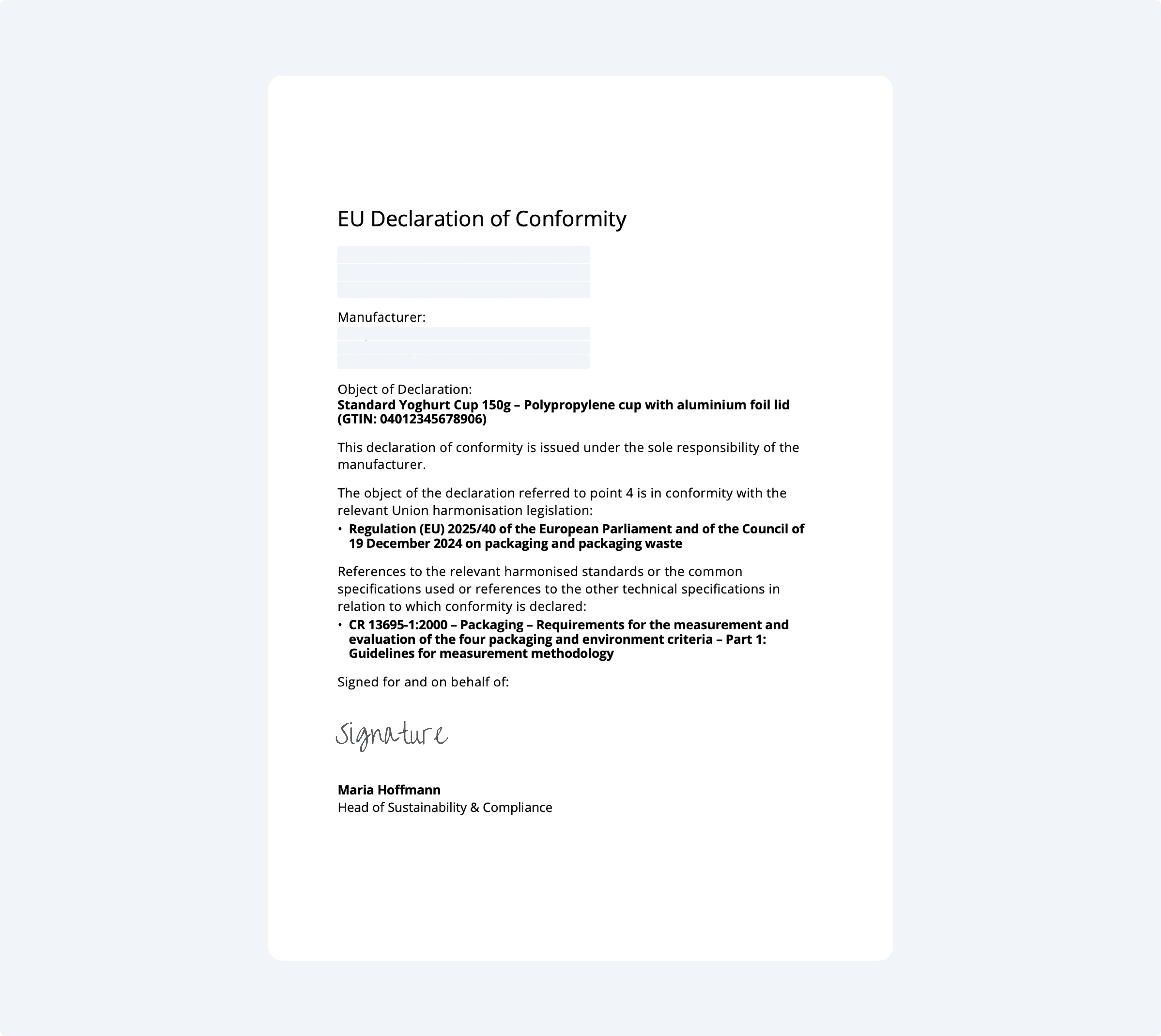
According to Annex VIII, each DoC must contain the following digestible information:
Unique DoC identification number
Unique identification number of the packaging
The manufacturer’s name and business address (and where applicable, the manufacturer’s authorized representative)
A formal statement of sole responsibility from the manufacturer
A section with clear description of the packaging object of declaration
A formal declaration that the packaging complies with Regulation (EU) 2025/40 (PPWR) and reference to the other Union acts applied.
A list of references highlighting the harmonized standards, common specifications, or other technical specifications used by the manufacturer
Authorized signatory details that include: place, date, name, function, signature
Please note that a packaging Declaration of Conformity can be prepared as a standalone document using the Annex VIII format or included within a combined document that also showcases your packaging’s compliance. When combined, it should clearly reference all relevant Union acts and be identifiable.
Who signs the Declaration of Conformity?
The declaration must be signed by either the manufacturer, an individual legally authorized to act on behalf of the manufacturer or their appointed representative (such as a company director, compliance officer, or senior manager). In addition:
There is no requirement for the signatory to be an EU citizen or resident.
By signing, the authorized individual legally confirms that the product satisfies all relevant EU compliance regulations.
To be valid, the declaration must explicitly display the signatory’s name, job title, signature, and the date it was issued.
How long does the Declaration of Conformity remain valid?
Manufacturers must ensure the Doc is available for inspection by authorities upon request for five years for single-use packaging. Reusable packaging is extended to ten years. This also applies to technical documentation.
How does the Declaration of Conformity work with Technical Documentation and the Conformity Assessment?
The relationship between these three elements is defined in PPWR Annex VII, Module A, which sets out the conformity assessment procedure manufacturers must follow before placing packaging on the EU market.
Under this procedure, the manufacturer first prepares Technical Documentation that demonstrates how the packaging meets the applicable PPWR requirements. This includes information such as packaging design, materials, compliance assessments, and supporting test reports.
The manufacturer then uses this documentation to carry out the conformity assessment and verify that the packaging complies with PPWR Articles 5–12. Once compliance has been established, the manufacturer issues the Declaration of Conformity (DoC).
The DoC and Technical Documentation must always work together. A Declaration of Conformity without supporting Technical Documentation cannot prove compliance, while Technical Documentation without a DoC means the manufacturer has not formally declared compliance.
What are the sanctions for not submitting a Declaration of Conformity?
Failure to issue or maintain a valid DoC may result in:
Border enforcement actions, including customs seizures or shipping delays
Mandatory product recalls or market bans
Direct intervention by market surveillance authorities
Significant legal liabilities and financial penalties
What are the most common pitfalls importers should avoid with PPWR’s Declaration of Conformity?
Mistaking General Certifications for PPWR Compliance: Standard ISO 9001 or food-contact certificates cannot substitute for a Declaration of Conformity. The DoC must explicitly cite the PPWR regulation.
Using a Single "Blanket" DoC: A single document cannot cover your entire inventory. Under PPWR, each unique packaging format requires its own distinct identification on the DoC. Only where the characteristics of the packaging (e.g. the size) does not affect the compliance with articles 5-12, a single DoC is sufficient.
Lacking a System for Material Changes: Updates to packaging designs or materials require an updated DoC. Without an active tracking system, you will end up holding obsolete, non-compliant documentation.
Missing the "Own-Brand" Rule (Article 21): If you market packaging under your own brand name, the legal responsibility shifts to you. In this scenario, you must draft and issue the DoC yourself..
Using Email as an Archive: Relying on your inbox for storage will fail during audits. Because documents must be retained for 5 to 10 years, you need a structured, searchable repository where each file is verified against mandatory elements.
Only generating your DoC when the auditor asks for it: DoCs are not reactive documents. Articles 15(2) and 18(2) explicitly state they must be drawn up or verified before the packaging is placed on the EU market. Waiting for an enforcement officer to ask for it introduces immense corporate risk. Under Articles 15(10) and 18(8), you have a maximum of 10 days from the receipt of an authority's request to deliver the complete technical file and DoC. If you realize your supplier data is missing or incomplete after the 10-day countdown starts, you will likely face immediate non-compliance penalties.
How can Recyda help?
Managing Declarations of Conformity across a large packaging portfolio can quickly become complex, especially as regulatory requirements evolve. With all relevant packaging data in one place, Recyda empowers teams to maintain a clear overview and visibility of compliance status across their packaging portfolios while reducing the administrative burden of managing documentation.
Recyda generates customizable templates that help standardize the creation of Declarations of Conformity, making it easier to create consistent documentation across your entire portfolio. Read more about how our PPWR software solution can support your DoC management.
Recyda's DoC example format:
Finally…
To understand the key elements of technical documentation (technical file), stay tuned for our next post, which will complete this two-part series.