PPWR
Published on:

Shahan Syed
Product Marketing Manager
Key Takeaways
Recognise the challenges with existing manual methods.
Explore how Recyda automates key stages of the reporting process.
Discover the 5 key benefits of automating these manual tasks.
An increasing number of countries now require producers to report the amount of packaging they place on the market and pay applicable Extended Producer Responsibility (EPR) fees.
Today, many companies still manage this EPR reporting manually, which is a complex and time-consuming process.
This is because data needs to be consolidated from fragmented internal systems or collected from suppliers. Most internal systems are not designed to store data in a way that it captures the additional attributes needed by regulations.
The reporting process itself adds another layer of complexity: reviewing lengthy guidelines and fee schedules, performing calculations in spreadsheets, aligning results with reporting requirements, and formatting submissions to match specific PRO templates — only to repeat the same process every reporting cycle.
Over time, this approach creates significant direct and indirect costs. It consumes time and resources, while also increasing the risk of non-compliance and possible fines.
The way forward is for producers to adopt a more efficient and automated process.
In this article, we explore how automating key parts of the EPR reporting process with Recyda can simplify compliance, improve accuracy, and reduce long-term effort — outlining both how it works and the benefits it delivers.
How to Automate EPR Calculation and Reporting with Recyda?
Recyda offers an end-to-end platform for EPR compliance, from data consolidation to preparing submission-ready reports for declaration. Here’s an overview of how it works.
Import Your Data
Start by importing portfolio data from your internal systems using various methods such as API integrations, file-based mapping, or direct uploads.
Your data is mapped to a structure that is optimised for EPR calculation and reporting, with composition details and additional details (such as colour, separability, density, applicable DRS schemes, etc.) rightly attributed to packaging units.
Automate Calculations
Select the country where you need to report EPR (from over 20 supported markets) and choose the relevant PROs where applicable.
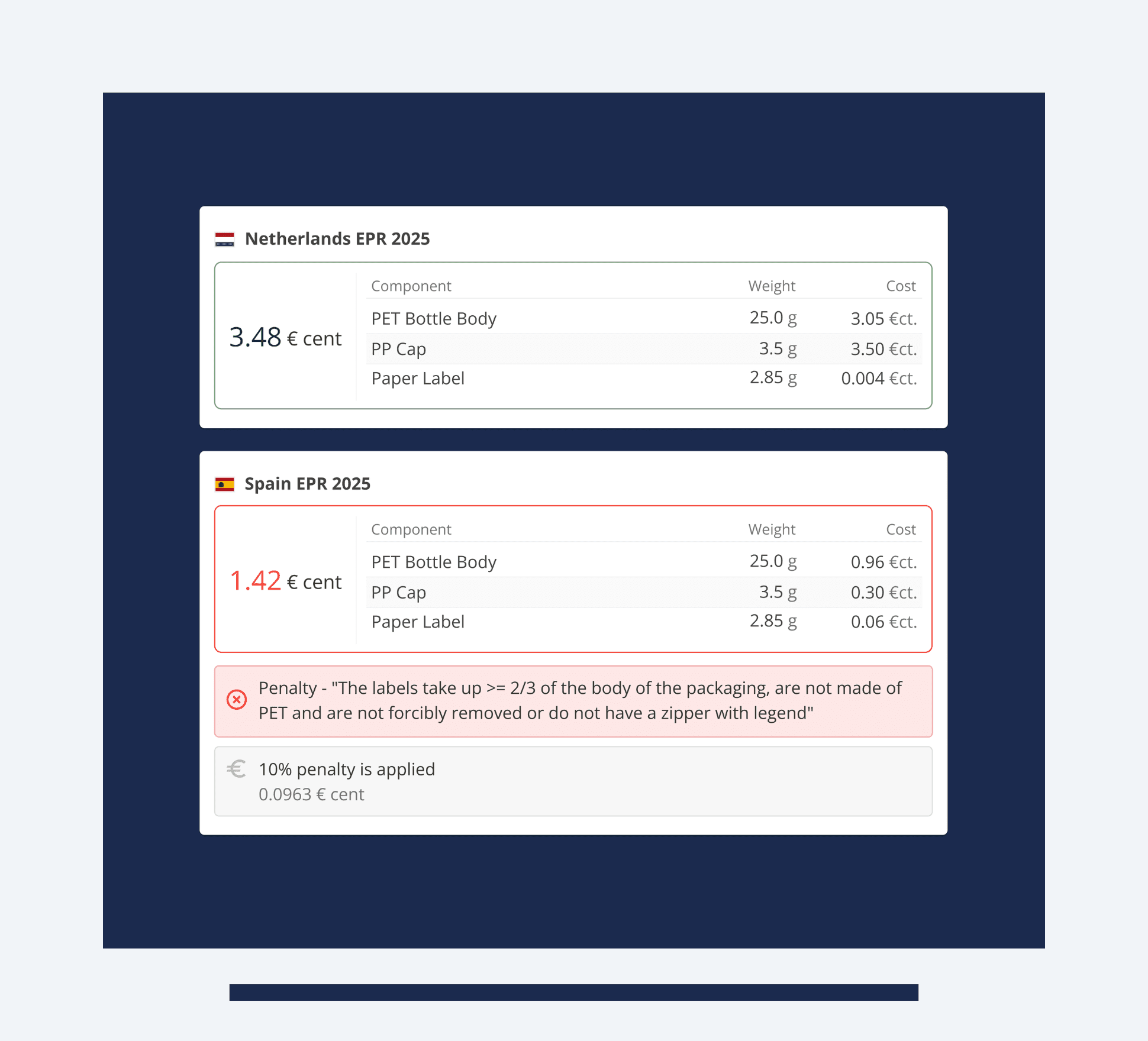
Our platform then automatically calculates the EPR fees for your packaging and its components, applying the exact rates and rules as mentioned in the chosen guidelines. This significantly reduces the manual work you would need to do otherwise.
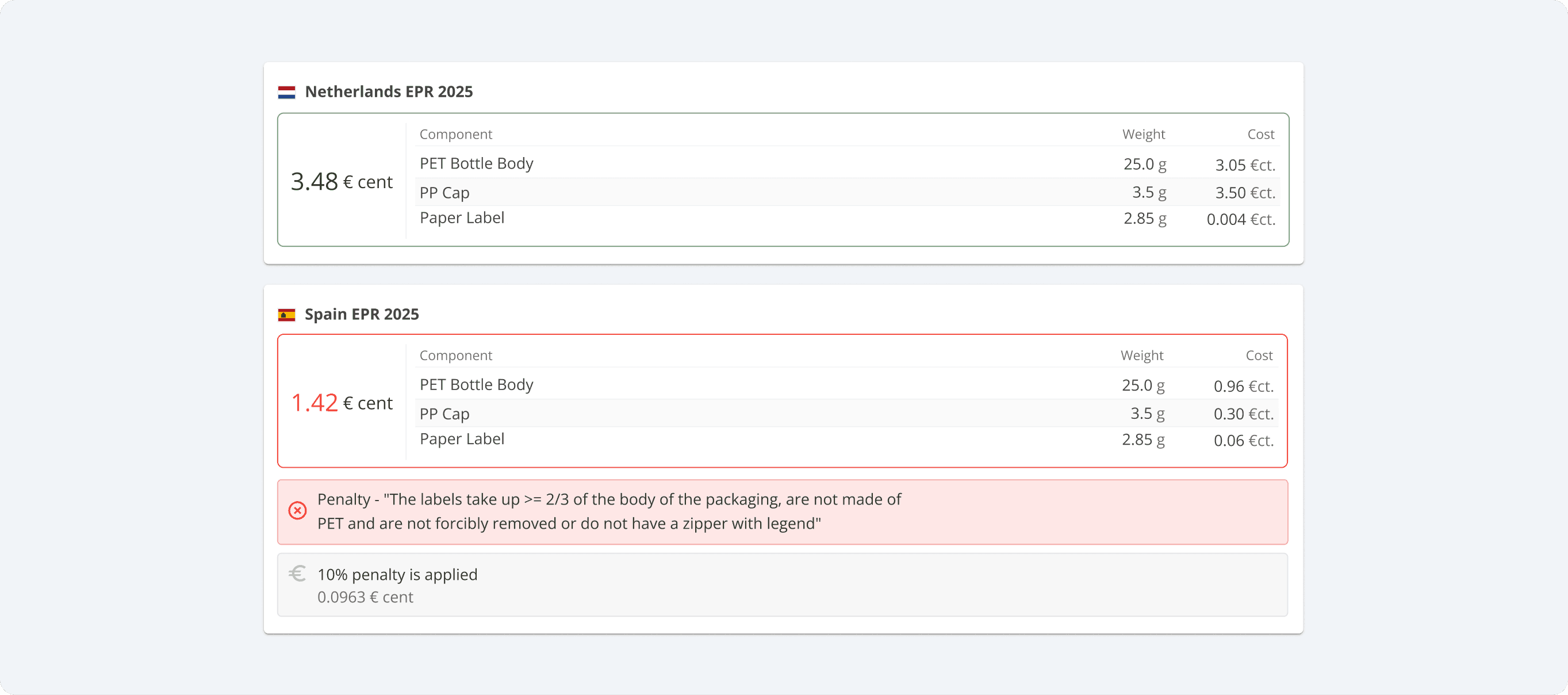
All of the calculations performed are audit-ready; giving you complete traceability of data sources and clear visibility into how every result was generated.
Generate Declaration-ready Reports
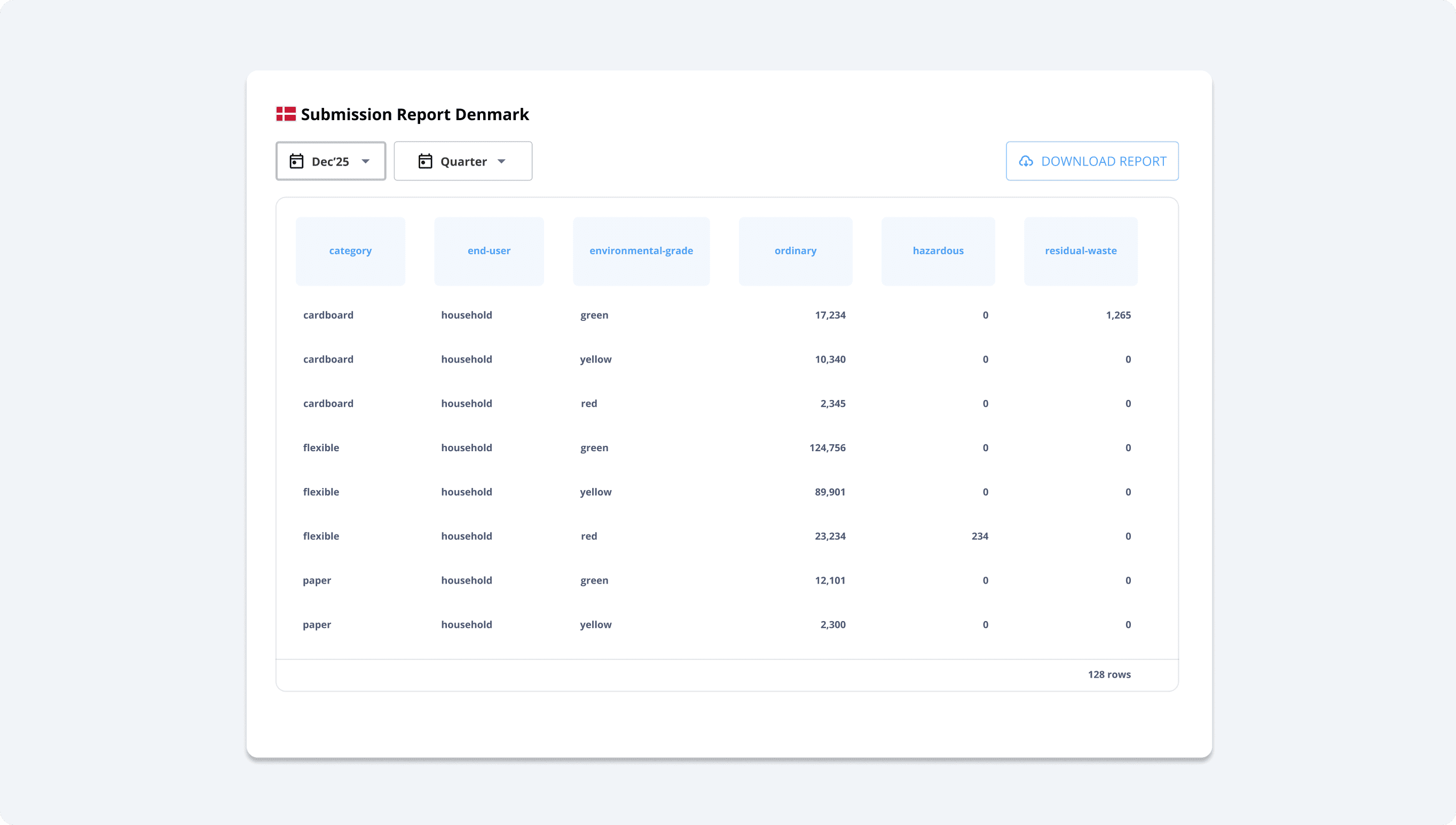
Choose a reporting period and instantly generate a report with calculations performed for all your packaging units, structured according to country or PRO-specific submission requirements.
Enrich Data
Our platform offers a structured process for data enrichment, where you can identify data gaps and additional information that could improve reporting accuracy.
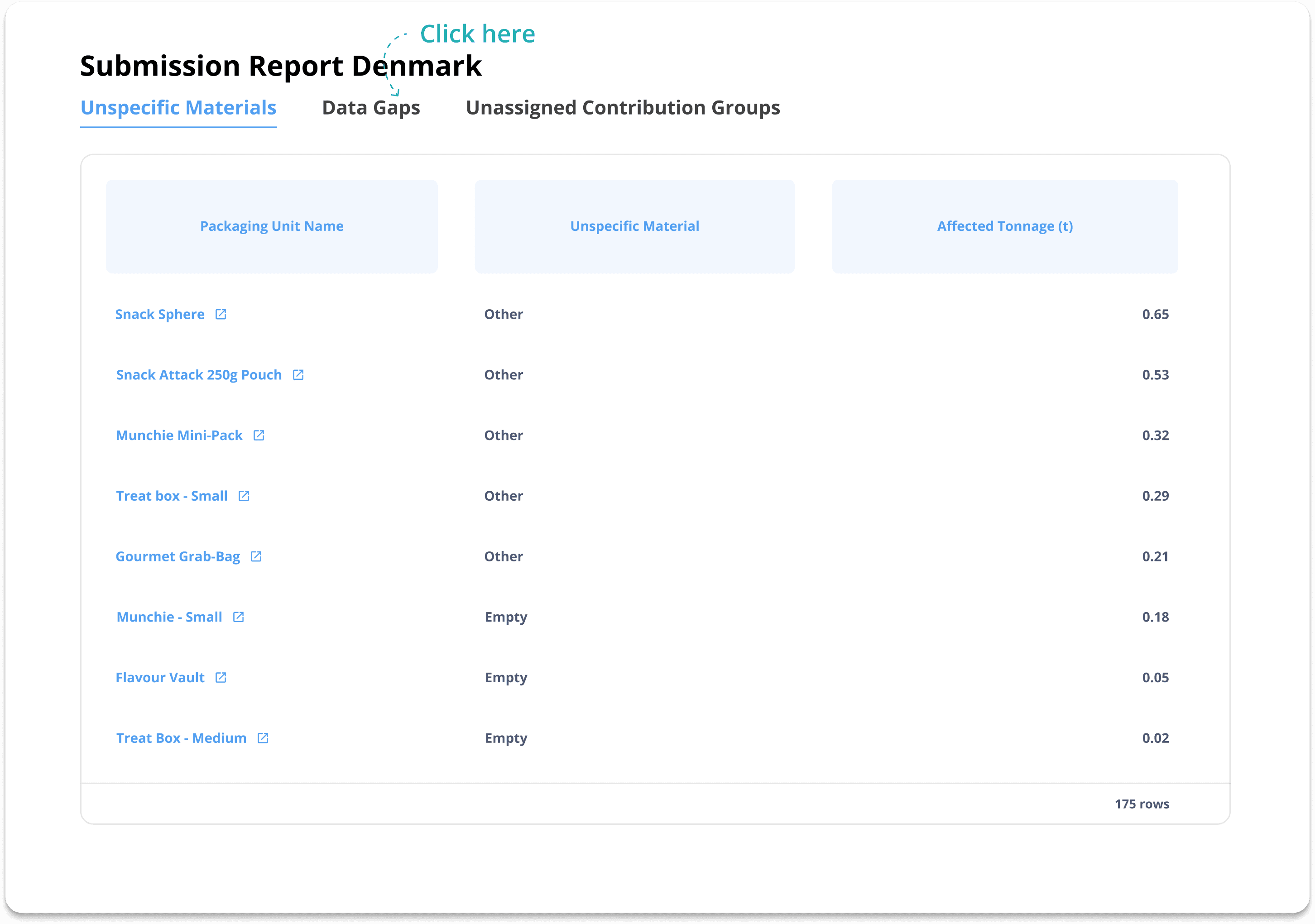
Based on the packaging type, the platform automatically detects missing attributes — such as colour, separability, density, and other information that is required by the chosen regulation.
It also flags vague material definitions in your data. For example, materials imported simply as “plastics” must be further specified (e.g., PET, HDPE) to enable accurate evaluation and fee calculation.
In addition, the platform identifies unassigned contribution groups and components with missing weight information.
You can manually fill in these data gaps via the interface or in bulk via logic-based heuristics. For example, you can apply a logic that all packaging from brands A, B, C are coloured, and those from brands D, E, F are opaque.
Benefits of Automation
From Reactive Reporting to Strategic Control
By establishing a structured system to manage and report EPR, you move from reactive, ad-hoc reporting toward a more strategic and controlled approach.
Automation removes manual, operational work, freeing your team to focus on the bigger picture.
You can now dedicate time to what matters more in the long run — understanding which packaging units drive EPR costs today, how these costs are likely to evolve in the future and the actions you can take to optimise them.
Save Time
The most direct benefit of using a system to automate reporting is saving on time.
You can skip the time consuming process of going through complex guidelines, working through spreadsheets to perform calculations, and compiling a report.
You also save significant time identifying and filling data gaps — a process that is otherwise tedious and time-consuming when done manually.
Ensure Accurate Reporting
Automation reduces the risk of human error, which improves reporting accuracy.
It also ensures that key details are not missed or overlooked, which may be required by regulations to calculate EPR accordingly.
Cost Savings: Benefit from Eco-modulation
Automation helps you rightly classify your packaging under any bonuses that you are entitled to receive.
Insights for Packaging Optimisation
Recyda also helps you identify any potential bonuses that you might be forgoing or any penalties you might be facing because of packaging design – a useful insight for packaging R&D to iterate and improve on.
Offload Manual Tasks to Automated Workflows with Recyda
As packaging legislation continues to evolve, a manual approach to EPR is no longer sustainable. The way forward lies in automating various parts of this process.
As explained above, Recyda’s end-to-end platform to calculate and declare EPR can help you here.
Ready to automate? Get in touch with us for a tailored demo, and begin your automation journey.