PPWR
Published on:

Biki John
Senior Content Marketing Manager
Key Takeaways
Understand the key packaging EPR laws in California.
Discover how eco-modulation links recyclability to packaging fees and compliance penalties.
Learn how a digital platform can help companies navigate complex and evolving packaging EPR laws.
Introduction
Extended Producer Responsibility (EPR) has long shaped packaging regulations across Europe, and now America is following suit. As new EPR laws gain traction across several US states, companies are facing complex requirements around data, reporting, and recyclability.
This article explores the latest EPR developments in California, the growing role of eco-modulation, and how a digital approach can help companies stay compliant and efficient in a rapidly changing regulatory landscape.
Unpacking EPR Compliance in California
EPR legislation in North America has accelerated in recent years. With several US states already enforcing EPR frameworks to hold producers accountable for the full lifecycle of packaging, businesses are tasked with proactively managing a diverse and increasing set of compliance obligations and stricter product labelling criteria. In this section, we focus on EPR updates in California.
Looking back at 2025, California was one of the states making the strongest advancements concerning packaging legislation. This is largely due to the implementation of its two landmark laws: the Plastic Pollution Prevention and Packaging Producer Responsibility Act (SB 54) and the Truth in Labelling for Recyclable Materials law (SB 343).
What is the Connection Between SB 54 and SB 343?
Senate Bill 54 (SB 54) and SB 343 establish an intrinsically linked regulatory system. Packaging that fails to meet the 'recyclable' definition set by SB 343 faces the probability of higher EPR fees under SB 54.
Conversely, maintaining compliance and using accurate labelling under SB 343 offers protection against potential legal liabilities and safeguards corporate reputation. Together, these legislative acts compel producers to implement design modifications that optimise both cost-effectiveness and environmental outcomes.
In one of our previous blog articles, we deep-dived into SB 54 by providing information on the critical updates brand owners ought to know.
For the purpose of this article, we will focus on SB 343, as well as provide more critical information concerning both pieces of legislation. It’s advised that businesses selling goods in California must understand both of these mandates.
What is SB 343 (California’s Truth in Labelling for Recyclable Materials law)?
While SB 54’s objective is to reduce plastic pollution and ensure that packaging waste is managed and paid for by the producers themselves, SB 343 targets ‘greenwashing’ (misleading environmental claims) by establishing a strict California-specific standard for the term ‘recyclable’.
Enacted in 2021, the legislation determines what can be legally marketed or labelled as recyclable under SB 54. It dictates that the chasing arrows symbol or any equivalent term can only be applied to packaging if it demonstrably satisfies specific, in-state benchmarks for how it is collected, sorted, and reprocessed.
How Does the Recyclability Factor into SB 343?
SB 343 states the criteria products must satisfy to be classified as ‘recyclable’. Specifically, the packaging must be routinely collected by programs accessible to at least 60% of Californians, be effectively sorted into specific material streams by facilities serving the majority of those programs, and finally be successfully sent to reclaimers for processing in compliance with the Basel Convention guidelines.
Furthermore, the packaging must adhere to specific composition and design criteria. For plastic packaging, this typically requires compliance with the APR Design Guide for Plastics Recyclability, which the law uses as a benchmark for design features.
Specifically, Section 42355.5 of the bill states that for a plastic package to be considered "recyclable" in California, among other criteria, it must meet the following design standard:
"For plastic packaging, the plastic packaging is designed to not include any components, inks, adhesives, or labels that prevent the recyclability of the packaging according to the APR Design Guide published by the Association of Plastic Recyclers.”
Alternative pathways to compliance exist, such as meeting established recycling rate minimums or participating in pre-approved, non-curbside collection programs, provided they align with other relevant recyclability and disposal laws.
What are California’s Key Packaging Dates?
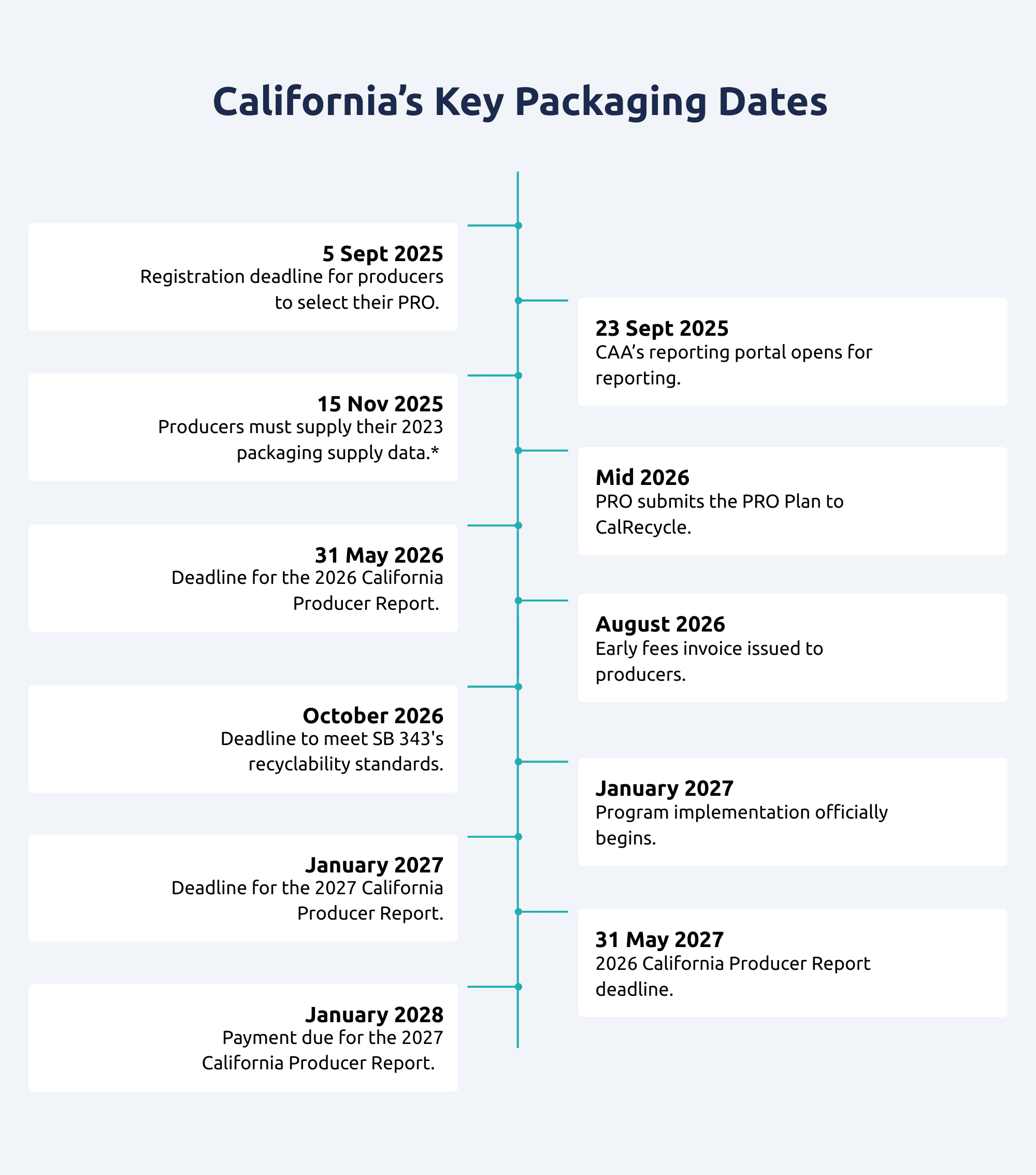
*15 Nov 2025 (Initial Baseline Reporting): Producers must submit their 2023 packaging supply data (weight, material type, etc.) to CAA. This data is used to establish the program's baseline and calculate future fees, which will not commence until 2027.
SB 54 | Key Compliance Requirements and Deadlines for Producers:
Join a PRO: Producers must join a state-approved Producer Responsibility Organisation (PRO) to coordinate and fund the EPR programme.
Meet Reduction Goals: Companies must achieve specific source reduction targets for plastic packaging, with a key requirement of a 25% reduction by 2032.
Achieve Recycling Rates: Producers must ensure that all single-use plastic packaging meets escalating recycling rates: 30% by 2028, 40% by 2030, and 65% by 2032.
Recyclable/Compostable Standard: By 2032, 100% of covered materials sold in the state must be recyclable or compostable.
The Consequences of Non-Compliance
These regulations carry some of the most stringent penalties in the US EPR landscape.
Penalties for non-compliance with SB 54 include:
A civil penalty of up to $50,000 per day per violation. These daily fines accrue until the breach is corrected.
The revenues from these penalties are directed into the California Plastic Pollution Mitigation Fund, which will be used to address the environmental impacts of plastic waste on communities.
Given the potential for crippling daily fines, businesses should view compliance with SB 54 and SB 343 not merely as a regulatory requirement, but as an essential cost of doing business in California.
EPR - How do California & Europe Differ?
While both the EU and California share the core principle of EPR - shifting financial and logistical accountability for packaging waste from taxpayers to producers - their execution differs significantly.
The primary similarity between the two lies in the use of eco-modulation, where fees are adjusted (lower for sustainable materials, higher for problematic ones) to incentivise better design, a concept central to the EU's Packaging and Packaging Waste Regulation (PPWR) and California’s SB 54.
However, the American system is decentralised and state-led, resulting in varying requirements and deadlines across the country, whereas the EU seeks harmonisation through unified directives and regulations.
How Best Should Brand Owners Prepare for EPR?
The impending expansion of EPR and eco-modulation mandates in North America necessitates a decisive shift away from fragmented data and static packaging assessments. Recognising this crucial industry need, Recyda has partnered with the Association of Plastic Recyclers (APR) to develop the APR Design Assessment Tool.
This new digital platform, slated to go live in Q1 2026, is specifically engineered to transform how brand owners evaluate and improve the recyclability of their plastic packaging portfolios.
The APR Design Assessment Tool digitally integrates the authoritative APR Design Guide, offering brand owners real-time, dynamic verification throughout their product development process. This system helps companies rapidly identify design flaws and address missing material data, ensuring their packaging meets the stringent recyclability criteria set by laws like California’s SB 343. This proactive, integrated approach is essential for mitigating supply chain risks, establishing auditable design claims, and strategically preparing for future eco-modulation penalties under EPR frameworks like SB 54.
All in all, Recyda's robust digital platform is designed to support companies globally. The platform offers a recyclability solution for American markets via the APR Design Assessment Tool. In addition, it helps streamline EPR reporting and declaration through a centralised system in both Europe and America.
Conclusion
The legislative framework established by California's SB 54 and SB 343 confirms that compliance is now intrinsically tied to verifiable data and packaging design.
Given the risk of penalties, businesses must prioritise robust data management and proactive redesign to meet the state's labelling and recycling standards.
This level of detail requires large enterprises to move beyond manual processes. Instead, a digital platform is the most effective approach to facing these evolving EPR requirements.